

ART & ITS FREQUENCIES
In Art and Its Frequencies, we invite artists to share their unique wavelengths of thought—their insights, processes, and cultural contexts—to create a polyphonic understanding of Shapes and Spaces. This practice, which we will continue in future exhibitions, reveals how art transmits meaning across varied registers of perception through spatial frameworks.
Frequencies. It is a conceptual framework where art is understood not just as static objects, but as dynamic transmissions—operating on different wavelengths of meaning, perception, and cultural resonance.
Explanation for Crystalline Composite
by MIA Nel
Crystalline Composite is what is created when you mix sugar with resins or binders. This term frames the sugar as a technical component of a high-end material. The common misconception: people associate sugar with food (which rots or melts) rather than seeing it as a mineral (which is stable).
Since sugar is not used as a standalone medium but instead a component of a new hybrid material I have created I cannot only refer to my medium as sugar but rather a component of the new hybrid material.
In engineering, a composite is a material made from two or more distinct substances that, when combined, create properties that neither has on its own—perfect for describing sugar mixed with a binder.
In both chemistry and art, an Organic Crystalline Composite describes a material where a structured, organic crystal substance (like sugar) is integrated with other materials to create a new hybrid with enhanced properties. When these are fused, the result is a “ bio-concrete.”

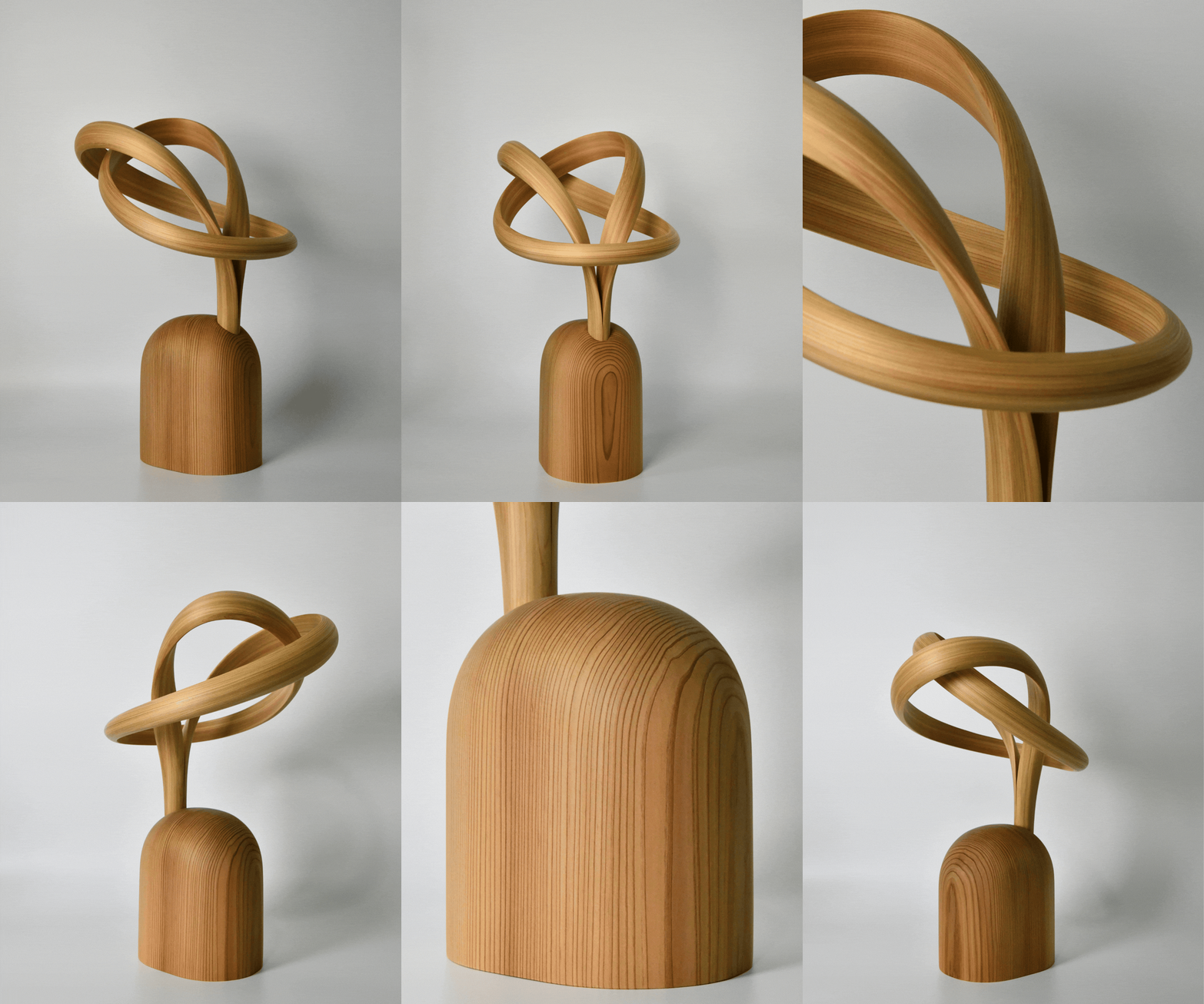
Tanagokoro (Palm of the Hand) by Kenta Hirai
Medium: Yoshino Cedar
My work begins with the quiet discipline of laminating and gluing multiple thin sheets of wood, each one bent carefully into form. I rely on straight-grained, naturally stable Yoshino wood — material long regarded for its exceptional quality — and once the layers are bonded, the structure holds its shape with remarkable consistency. While humidity may introduce subtle shifts to the surface over time, these variations are gentle, making the material especially suited
for objects or mirrors that are handled less frequently.